In his book, The Condition of Postmodernity, David Harvey identified the loss of meta or grand narratives as one of the key differences between the modern and postmodern periods. Harvey explained that the artists of the modern age still viewed their role as interpreters of the metanarratives or universalisms found in everyday life, in the hope that these would ground us as individuals in a larger vision of what it means to be part of a collective society.
The postmodern age that followed forced us to question the power structures that determine which narratives are valid and which are not. It also created a society highly focused on the individual. Sceptical of sincerity. What this reproduced culturally was transactional. Cold. Literary theorist Fredric Jameson argued that the postmodern turn was itself the cultural logic of late capitalism. That the fragmentation and retreat into the self were not a free choice but a symptom of what this economic order produces when it dissolves the collective.
In his work, The Political Unconscious, Jameson insisted on a different path. Instead of abandoning grand narratives altogether, he argued that art and narrative cannot exist outside the material and ideological conditions under which they are made. For Jameson, the ultimate horizon of interpretation is the metanarrative of class struggle— not one narrative among many, but the condition that produced them. To strip art of this political consciousness is to rob it of exactly what makes it so powerful. So, of course, the insistence on separating art from politics is itself a political act that serves power.
We see this magazine as a place where such ideas can be formed and debated. A space to explore how we, as artists, can imagine beyond what is. Not to provide an escape, but to confront what is now and what might be possible. In the first edition of Metanarratives, we ask: What is the role of art and politics in the age of postcapitalism?
—Danielle Maisano
Fuck / Balfour
Let all the clocks stop / Let all our attentions be drawn / Let silence fall / for the dog deep in the manger / the cat crushed by beams / I want the phosphorus to clear / enough for us to search for / to look for and find / the little pink slipper / the grooves on its sole worn down and smooth to touch / Let us see the foot it cups and the dust under the toenail a mother once cupped / once took a toothpick to / gleefully scraping out the muck as the child squealed in precious laughter / her breath in full bloom / Let us see her ankle now / still and scorched and thin as stems / Let us take in this slim seared limb sticking from the rubble / the hand just here / the half head there / a thumb’s humble knuckle / all / each human morsel like the tip of a tongue telling its truth / bearing its own witness / quiet among the rumbling / the rumbling / Hush now / Zoom out now / Pan right / to the tank / Look into its round black mouth / down the gullet of hell and fire / down the star spangled dark / the jacked-up union of metal and madness / I want us to flinch when it barks / to startle when it belches / to wince when it recoils / when it breaks out to smash to smithereens the already shelled home / our pink slipper slipping deeper into the mound the soldier is climbing now / as if to conquer a mountain / and driving into this fallen home / this human heart / a pole / stabbing / stabbing / until its white and blue flag flaps with the storm rising behind / the fire in the sky / and the barefoot soul / soaring free
– Inua Ellams
The Last Cigarette
Art and Political Prefiguration
By Elettra Stamboulis
I ceased smoking in May 2023: it was not a simple matter. No, I did not intend to quit smoking, but to detach myself from him, from my grandfather.
He would awaken at five in the morning, a habit acquired during his confinement and imprisonment. He would perform a series of push-ups each morning—another custom borne of prison, a means of survival in enclosed and cramped spaces. Then, he would light a cigarette. When I was in Athens, I slept in their room. The smoke never bothered me. My grandmother recounted that when he was on Makronisos, I believe during the Civil War, he would refuse the food parcel; he wanted only cigarettes. When I asked him, shortly before his death, why he preferred cigarettes to feta, he told me, “You see, when you find yourself in a state of humiliation, deprivation, when they seek to strip you of everything, most of all your dignity, you must perform a gesture that restores you to the freedom of your human being. The cigarette is useless, precisely for this reason it is essential in such moments.” I believe art is like those cigarettes, perhaps useless, yet essential.
In the new century, we have witnessed an explosion of the most insidious and ambiguous aspects of financial capitalism, of post-capitalism, and within this explosion, art too has undergone a detonation. The artist, who had become emancipated from the role of courtier in the 19th century, the artist who had seen their role transform, no longer an instrument of power but an interpreter of conflicts and wounds—behold, that artist has now been silenced by the art market, by its voracious appetite for digital images, and is easily blackmailed, precisely from a financial standpoint and beyond.
From 1999 to 2019, for twenty years, I worked with many artists, primarily from the international underground: I speak of the generation born between the late 1960s and the 1970s, in particular those from North Africa, Turkey, Lebanon, in addition, of course, to Italians and Europeans in general. Over the years, I became an expert in visas, one of the most complex and delicate matters for the very possibility of an artist’s growth and dialogue with other places.
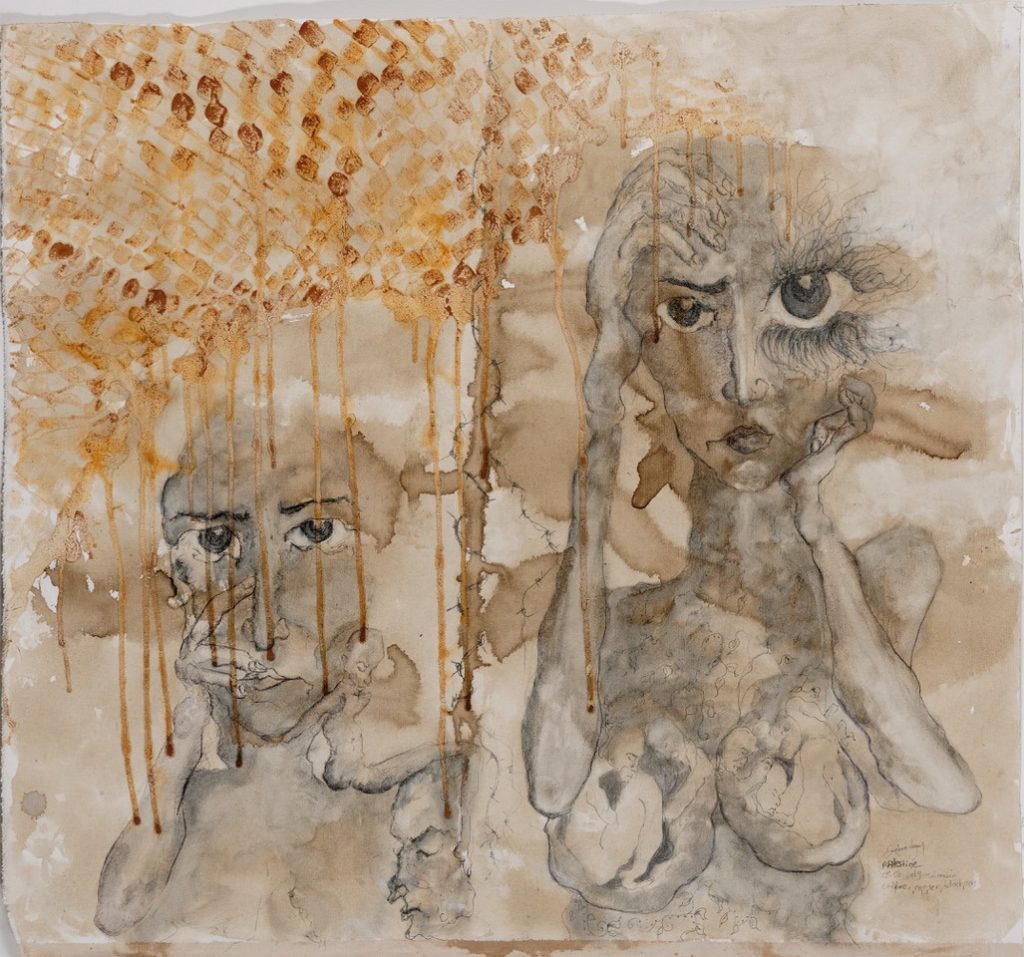
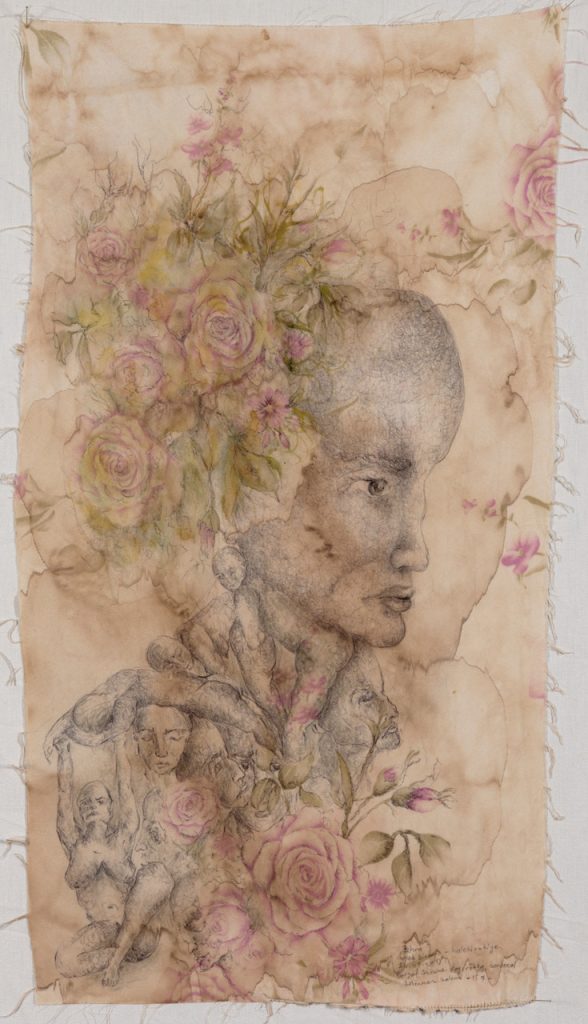
In 2019, I encountered an artist who had been in Turkish prisons for creating a drawing on a photograph of soldiers celebrating after the destruction of Nusaybin, in Turkish Kurdistan in 2016—an event that caused the displacement of more than 300,000 Kurds from the area and the destruction of 70% of the city. Zehra Doğan, not yet thirty years old, had been incarcerated for 2 years and 9 months for that drawing. I became acquainted with her work in a small town in Normandy, Morlaix, where some French activists had exhibited works she had smuggled out of prison through a discreet channel between Turkey and France. Above all, I met Naz Oke, a Turkish human rights activist naturalised as a French citizen, who saved Zehra’s works, archived them in her home, and, together with me and a few others, took care of her upon her release from prison. Her exhibition, “We Will Also Have Better Days,” was the first in a series I organised in Brescia, featuring artists who, due to their ideas and their work, had been forced to leave their countries. Art’s refugees, in short. Some believe these artists receive attention for what they say, for what they represent, and not for what they create. As if a viable schism could exist between art and life, between thought and action.
Zehra Doğan, Palestine, coffee and mixed materials on paper, 2017, artwork presented in the exhibition “Avremo anche giorni migliori” in Brescia in 2019.
Nevertheless, it is true that it is highly risky for an artist to be confined within a cage of meaning reduced solely to their personal history and the history of their country or people. The propensity to label an artist as ‘political,’ only to discard them the moment they or their cause are no longer ‘in vogue,’ or no longer marketable in terms of media attention, is a central theme of their potential for blackmail.
Zehra now resides in Berlin, unable to return to Turkey. She collaborates with an Italian gallery that provides her with financial support, enabling her to sustain her family who remain in Turkey. Yet, her visa stands as her most crucial work, the one she preserves and worries over daily. Her artistic and political credibility perpetually hangs on the facile categorisation of “the prison artist.” Is it possible, she wonders, to be recognised as an artist, a feminist, a Kurd, an activist, without succumbing to the supermarket-style classifications of the art fairs? A difficult, if not impossible, endeavour.
Navigating any of the significant art fairs, those that constitute the lifeblood of the art market index, reveals that these artists are, in essence, substantially excluded. They can exist only when bolstered by public and private foundations concerned with the post-colonial repositioning of the artistic gaze. These entities impose display rules, sometimes dismissed as excessive or moralistic, yet they represent the only possible leverage to ensure that African American artists find a market, that artists from the global peripheries are recognised and promoted, and that our perspective decentralises itself, becoming curious about the perspectives of others. The sovereigntist, authoritarian, and post-fascist movement—which views Trump as its most influential politician but boasts significant exponents across Europe, Latin America, and Asia—is not disinterested in this curatorial debate. The events of May 2025 at the Whitney, with the cancellation of the performance No Aesthetics Outside my Freedom: Mourning, Militancy and Performance, are emblematic: self-censorship is undoubtedly one of the most widely practised forms of compliance by cultural institutions. When it comes to Gaza or the Palestinian question, this instrument continues to inflict damage, primarily upon our capacity to comprehend Palestinian artistic culture.
Zehra Doğan, Captivity of nostalgic dreams, coffee and mixed materials on a prison sheet, 2017, artwork presented in the exhibition “Avremo anche giorni migliori” in Brescia in 2019.
If you are not acquainted with the artists of a country, your potential for empathy towards its inhabitants diminishes considerably. This holds true for all arts and all cultural forms. Furthermore, cultural geography today plays an outsized role, amplified by the weakness of its cartographic counterpart in the age of Google Maps. We can, indeed, identify a locale’s restaurants from afar, but we cannot discern its culture. A form of colonialism proliferates in the wake of the globe’s digitalisation.
The insistence with which right-wing factions of all intensities—there being no distinction in this between conservatives and neo-fascists—defend a unique cultural identity, primarily the so-called Western one, but also neo-colonial narratives like those in Putin’s Russia or neo-Ottoman ones in Erdoğan’s Turkey, is precisely aimed at creating a uniform, normalising discourse. It promotes an artistic vision that questions none of the contradictions of the contemporary. Normalising perspectives is part of the autocratic discourse, and it works.
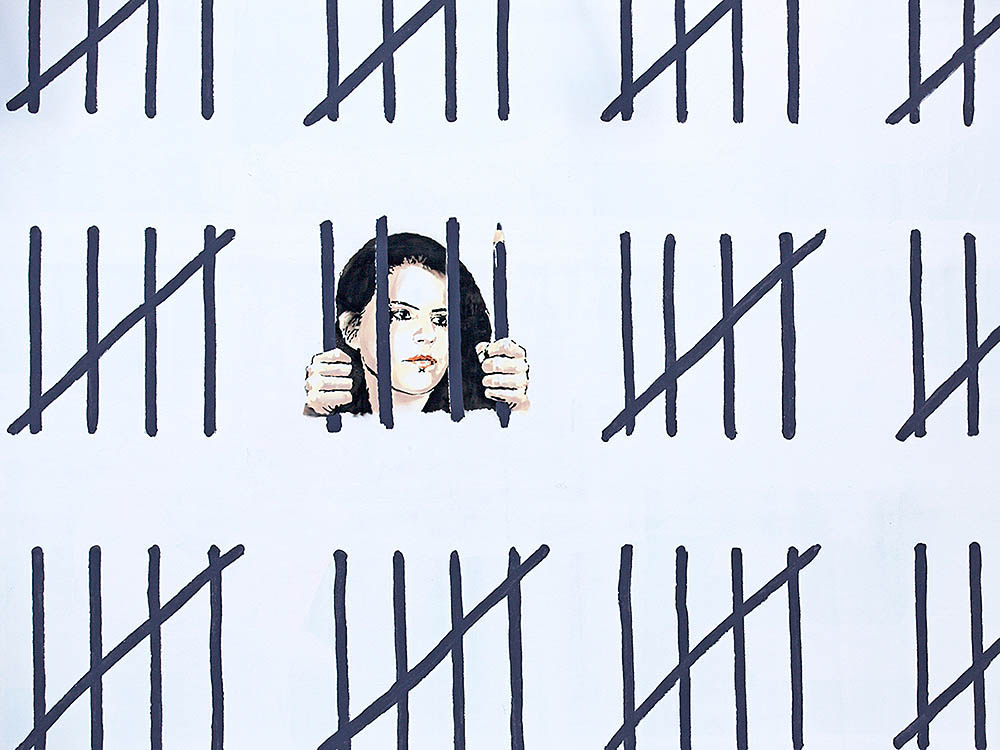
The violence of the system is not only the spectacular, precise violence of bloodshed: there is a violence of tedious and insubstantial forms designed to render us all subjects, such as the practices of visas and residence permits, which are widely used to silence and exclude artists and intellectuals. These bureaucratic forms of control, employed as structural violence, do not target everyone: merely complaining about “bureaucracy” in our lives does not automatically render it an element of violence, though it is certainly a nuisance. It is the implicit and explicit forms of blackmail underlying the issuance of residence visas, impacting primary rights like freedom of expression and movement, that constitute structural violence, to use David Graeber’s term. This same Graeber, when analysing the processes by which irreverent artistic forms were used during the alter-globalisation protests of the late 1990s, and the police reactions to them—particularly the giant puppets—he speaks, in his analysis, of prefigurative politics. That is, groups deciding to act as if they were already free, without waiting for a liberated future. In a certain sense, the artistic practices of dissident artists possess precisely these characteristics. They act as if they were already free to express themselves without censorship, without propaganda, with their gaze liberated. Zehra Doğan not only took the liberty of transforming a photo of Turkish military armoured vehicles into scorpions, but she continued to paint in prison using coffee, food residues, menstrual blood, and, obviously, cigarettes, thereby checkmating the system of liberty deprivation perpetrated by the prison regime.
Banksy’s mural at Bowery Wall asking Zehra’s release
The art market imposes other constraints, often bureaucratic, typically exclusions stemming from a censorship that limits our capacity for a full gaze. This is a censorship born more from forms of cultural conformism than from conscious exclusion. Any exhibition that revisits a period of genuine liberation exposes this aspect: many of the artists who played a relevant and crucial role in that period are simply absent from subsequent phases of normalisation.
True art is prefigurative politics; that is, it allows us to imagine ourselves free even when we are not. It is within that empty space that we must look, avoiding wasting time on the shelves of mouldy and conformist products in official art fairs. It is, precisely, our last cigarette.
When will I tell you?
my love that it is all
almost
over
that all forests bleed
that we burn we burn we are burning
that there will be no more whale song
no fleeting pudu for your blood to discover
that there is no time for you to have babies
By Xaviera Ringeling
Art and Its Revolutionary Potential
By Raul Martinez
Our perceptual environment is saturated with cultural products that capture our attention, entertain and distract. Yet, because they are funded and disseminated to maximise the profits of this or that megacorporation, they typically fail to satisfy our deeper hunger for meaning and beauty. By contrast, art offers nourishment, food for the soul. This implies a conception of health: art can make us better somehow. Wiser perhaps.
The analogy can be pushed further: cravings for sugar, fat, and salt once helped our ancestors survive scarcity; today, surrounded by excess, these ancient reward circuits are systematically exploited. Addiction has become one of the great engines of modern commerce. Whole industries now specialise in hijacking once useful instincts. This also applies to culture. The commodification of sex, violence, and superficiality profits from entrenched biological responses. Algorithms have perfected the manipulation of our needs, keeping us hooked by exploiting our anger, arousal, fear, and disgust. The vacuum of meaning, beauty and goodness this leaves inside often keeps us coming back for more.
Art is an honorific term, one that resists definition, but the nourishment it offers is very real. In his classic account of life in a concentration camp, Man’s Search For Meaning, Viktor Frankl makes it clear that beauty, in whatever form it may come, is no luxury:
As the inner life of the prisoner tended to become more intense, he also experienced the beauty of art and nature as never before. Under their influence he sometimes even forgot his own frightful circumstances. If someone had seen our faces on the journey from Auschwitz to a Bavarian camp as we beheld the mountains of Salzburg with their summits glowing in the sunset, through the little barred windows of the prison carriage, he would never have believed that those were the faces of men who had given up all hope of life and liberty. Despite that factor—or maybe because of it—we were carried away by nature’s beauty, which we had missed for so long.
At our most fragile and vulnerable— when life cracks us open—we are unusually receptive to the beauty around us, aware of its transcendent power. Frankl describes how, despite being worked to the bone and pushed to their physical limit, prisoners with privileged positions within the camp—those who were forced to collaborate—made time for poetry, songs and jokes. Even ordinary prisoners, utterly exhausted, attended these gatherings, often missing meals to do so. As clear an illustration as you’ll get that bread alone is not enough: we need roses, too.
Today, we have more access to art than ever before. Mere clicks away for anyone with an internet connection, an abundance of films, music and literature awaits. Though it requires conscious effort in a predatory landscape intent on capturing our finite attention, ample sources of cultural nourishment are within reach. Yet, despite this treasure trove, the impulse to create remains undimmed, for the act of creation—individually and collectively—with all its messy complications, is itself uniquely meaningful. An alchemic process by which we can turn experience into beauty. When creation is collective, the process is an end in itself, one well suited to strengthening the bonds of community on which resistance depends.
It is no coincidence that much of the most powerful art emerges from the oppressed. From the cotton fields of the American South to the prisons of apartheid South Africa, from Indigenous lands to urban streets, from jazz and the blues to Nina Simone and Langston Hughes, from Mexican muralism to the magical realism of One Hundred Years of Solitude, the marginalised and the poor demonstrate what mystics have long known, that suffering is the soil in which our sensitivity to beauty grows.
The most profound contribution of art is easily missed. Through deep encounters with beauty, we access a mode of awareness more essential—and more enduring—than any of its instantiations. Art is participatory. What we experience as art emerges from a meeting between the perceiver and the perceived. Art’s power does not reside in artefacts. It is a relationship. The perceiver as much as the perceived is responsible for the experience. To be deeply moved by an epic tale or subtle sonnet we must approach it in the right way, opening ourselves, becoming present, attentive, still. It requires a calming of the mind, an opening of the heart.
Sages over millennia have taught how this open, present state can be cultivated without any external catalyst. Whether it is Meister Eckhart or Thich Nhat Hanh, the same message can be found: altering the perceiver alters the perceived. In the right state of mind, the apparently ordinary, trivial and routine acquire deep meaning, beauty and salience. Beauty lives not in the object, but in the quality of attention we bring to it. This may be what the legendary Russian film director Andrei Tarkovsky once tried to articulate:
When I speak of poetry I am not thinking of it as a genre. Poetry is an awareness of the world, a particular way of relating to reality.
This is an empowering idea. We all know that in a distracted state of mind, we can miss the latent value of exquisite paintings, prose and plays. In the same way, we can miss the wonder of life itself, moment to moment, breath to breath. We miss it when our attention is fractured, disturbed, clouded. We miss it when ego dominates.
Where does political transformation enter the picture? I would suggest that though the creation and experience of art can have far-reaching political consequences, it will forever resist co-optation for political ends. Political struggle aims at challenging and redistributing power by organising, influencing, and uniting people around compelling narratives and identities. The fight to survive the selection pressures of political life—even when that fight is noble—demands compromise and calculation. This is not to deny genuine overlap. As Orwell pointed out ‘The opinion that art should have nothing to do with politics is itself a political attitude’. Politics is an integral part of life. We need more art in our politics, and more politics in our art. Indeed, the choices we make in the domain of politics can themselves be a form of art. Choices are creative acts, a form of communication that can inspire, uplift and nourish. They can, in and of themselves, be beautiful.
Orwell, however, goes too far when he writes that ‘All art is propaganda’.Though lines are routinely blurred, and any strict taxonomy is doomed to failure, the difference lies in their relationship to truth: art seeks revelation, not persuasion; understanding, not blame; insight, not victory. Art with explicit political themes does not simply aim to alter the beliefs stored away in our heads. It aims to move us, change how we feel, expand our understanding—all in ways that could never be reduced to a slogan, ideology or manifesto. The best of Charlie Chaplin and Ken Loach are wonderful examples. Art communicates holistically, connecting us to numerous others and long-alienated parts of ourselves.
It would be a mistake to try to turn our artistic creations into the handmaidens of political revolution. An education in power and its abuses plays an essential role in struggles for change and art will always amplify the power of this effort. But, though there can be meaningful overlap with art, political education is a different endeavour, one to which the heights of human creativity can never be reduced. Instrumentalising art always risks robbing it of depth and complexity. One of art’s virtues is that, unfettered by the intense demands of worldly power competition, it can keep us honest, reminding us that reality is richer than the models of it we adopt. That truth lives beyond group-sanctioned dogmas, beyond the certainties of good and bad, us and them.
Civilisation will not survive long without mass political resistance, but alone it cannot solve our most pressing problems, the deep evolutionary roots of which have generated warfare, domination and inequality for ten thousand years. Navigating these problems will require a transformation of both inner and outer worlds: something like a civilisational redesign alongside a cultural enlightenment. For those open to it, art is a passage into fuller, richer ways of being, from which elements of this enlightenment might emerge. Each time we tread this path, we are changed in ways that send ripples, large and small, through the collective consciousness. This cultural process transcends the familiar pattern of expansion, corruption, decay and collapse that mark the life cycle of human societies. It is deeper, slower, longer.
The revolutionary potential of art does not lie primarily in its capacity to foment struggle, though this may be a secondary effect. Its potential is not distant and societal, but immediate and personal, with each private transformation opening up possibilities at the level of the whole. Art is a means of altering consciousness here and now, of changing the quality of our attention, of eroding the psychological walls that enclose our hearts, cage our imagination and dull our sensitivity. Its potential lies not in the realm of doing but being. From the altered consciousness that it invites us to access, new worlds are revealed— worlds in which the line between the mundane and the magnificent dissolves. Such inner revolutions are the foundation on which any lasting outer revolution will be built.
Seema
By Shirin Neshat
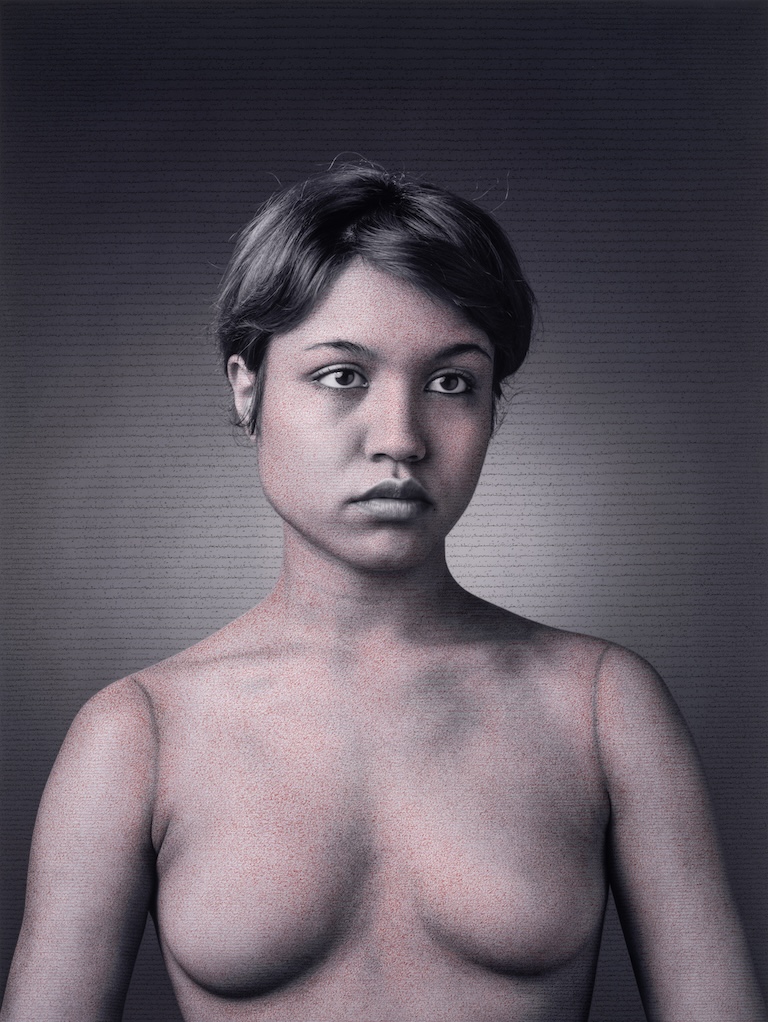
Seema, from Do U Dare! Series, 2025, C-print & ink, Courtesy of the artist and Lia Rumma Gallery, Milan/Naple
The Encampments: An Interview with Director Michael T. Workman
by Danielle Maisano
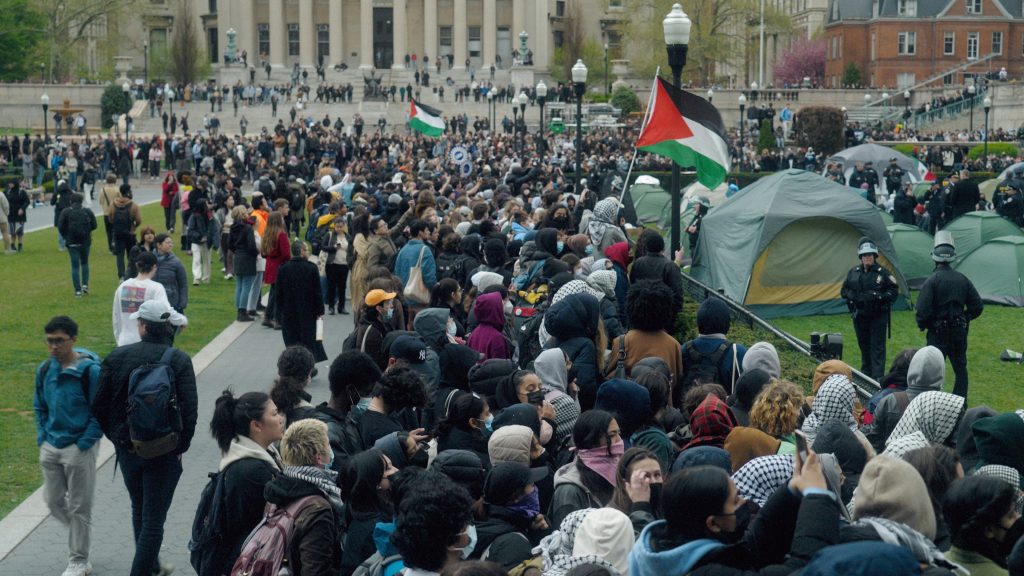
In April 2024, protests erupted on campuses across the U.S. and beyond, opposing the genocide in Gaza and the continued support for Israel by governments and institutions. In the U.S., the centre of the movement began at Columbia University, a school steeped in the legacy of student activism and a tradition of antiwar protests, which ironically, the university proudly claims. For weeks that spring, the world watched as students peacefully gathered and were met with brutal state repression. Media coverage portrayed the Columbia protesters as antisemitic extremists, diverting attention from their actual demands: an end to the war in Gaza and divestment from Israel.
The Encampments, directed by Michael T. Workman and Kei Pritsker, tells the story of student protesters in their own words, interwoven with footage of the genocide unfolding half a world away. This devastating imagery keeps the purpose of the protests unmistakably clear, highlighting the absurdity of silencing those who speak out against such senseless violence and loss of life. Two years have passed since the events captured in the film, yet the war continues, while the United States and other Western governments intensify their crackdowns on dissent. We spoke with director Michael Workman about how the film not only confronts the brutal realities of the present but also underscores the enduring power of peaceful, collective action in resisting them.
Danielle Maisano: This film was shot in 2024, and even though it feels like so much has happened since then, the film remains incredibly powerful and important. Could you tell us how you became involved in this project?
Michael Workman: This project started as a collaboration between me and Kei Pritsker, the other co-director. He’s a journalist at Breakthrough News and had been following the student movement at Columbia since right after October 7th. When the encampment was about to start, organisers called him up as one of the press they trusted to be there. They told him they were going to pitch some tents on the lawn, they didn’t know what was going to happen but wanted him to come and cover it.
He ended up staying for the next 12 days filming. At first, he planned to make a YouTube explainer video, which is what he usually does at Breakthrough. But through conversations, he realised maybe it should be turned into a feature documentary. That’s when Kei reached out to me. I came on board right after the encampment was raided and came to New York, worked on interviews, producing, working with students, and editing.
We finished the film in about seven months, which is a really short turnaround time for a feature doc. But we wanted to strike while the iron was hot. Most of the time with documentaries, they want you to wait until something is basically over, and then you make a film about it that has all the right takes in hindsight, but you can’t really affect change in the moment. At the same time, people are always talking about affecting change in that way. But we wanted to release something while things were still ongoing, to be a force in changing the narrative around the encampments.
Danielle Maisano: I was reading about how one of the showings in L.A. was stormed by police. It made me think about the way Latin American Third Cinema films like The Hour of the Furnaces or The Battle of Chile were often shown secretly. Those films both documented events while actively challenging the official narrative. I think your film really embraces that tradition by not simply documenting a historical moment, but also attempting to transform it. Was that something you consciously thought about?
Michael Workman: I’m definitely inspired by those world cinema movements for liberation that attempted to challenge the status quo. One of the most important things is telling stories that are risky to tell, stories the powers that be don’t want you to tell, which is very hard under a capitalist framework in which all of the funding mechanisms are run by capitalist corporations and their foundations that ultimately also have investments in Zionism and imperialism.
So it’s hard to make films that truly challenge those institutions, because they are the ones that also fund all of the artwork that is being made in the U.S. and the West. For us, it was about telling stories that couldn’t be funded with the politics that they have and trying to find ways to get them out. Finding alternative methods of funding and releasing films to make sure they can have a high impact. We understand that we’re basically operating on enemy territory, more or less. We’re not at the point where we have to do secret screenings of these films because of a complete fascist takeover, but we’re moving in that direction.
The powers that be have really effective forms of censorship, and those forms of censorship are not ever deemed censorship. They’re just someone saying, “You didn’t get this grant, it just wasn’t quite good enough. It was a really competitive year.” The same thing goes for film festivals and distribution. That’s how censorship functions in capitalism. For us, it’s also an opportunity to talk about these things and to hopefully expose not just the lies about Palestine but the lies of imperialism in general.
Danielle Maisano: Your film focuses a lot on connecting the pro-Palestine struggle to broader struggles against imperialism. Of course, that’s never talked about in mainstream media outlets, especially in the U.S. Can you tell us more about how you approached that connection while making the film?
Michael Workman: We always wanted the film to be contextualised. We wanted people to actually understand why the students did what they did, because we saw that the media was completely doing the opposite. They were trying to decontextualise the events and not allow the students to speak about the things that were inspiring them and moving them to take the actions that they did.
So part of doing that was to look at the history of the movements the students were drawing inspiration from: the anti-apartheid struggle in South Africa, the anti-war movement during Vietnam, and previous student movements at Columbia. These movements were all connected to greater struggles against imperialism. What’s happening in Palestine today mirrors what U.S. imperialism has done in Vietnam and elsewhere: using force to bend nations to its will for capitalist exploitation. That was something that was just inherently part of the story, if you actually look and try to find the truth.
The media refuses to make those connections because they are the main propagandists of imperialism. Doing that would expose their hand as not the balanced force that is always looking at all sides and trying to find the gray area. Really, they are the primary ideological force behind the justification of imperialism. We wanted the film to reveal those links clearly.
Crowds and supporters observe the encampments on Columbia University’s Campus in 2024
Danielle Maisano: What obstacles did you face in getting the film made and distributed?
Michael Workman: We knew that we needed to get the film out fast enough that we wouldn’t have time to seek the normal funding avenues for documentary films, like applying for grants and foundations. We also knew that we didn’t want to censor our politics, and we knew that that process really requires changing your politics to fit the politics of the foundation. So we had to search for alternative funding options and be very thrifty, basically, to try to make the film as cheaply as we possibly could.
Our first bout with censorship really was at the film festival stage, when we were submitting to different festivals. We know of a lot of internal turmoil that happened over film selection between the people who were selecting the films and the leadership, who were worried about the politics of the film and that it wasn’t “balanced” enough, and worried about their funders and what they would think of the film. I don’t want to be more specific than that, but that was happening behind the scenes, absolutely.
There were also groups of online Zionists who, when they would see that the film was going to be screening at a theatre, would bombard the email inbox and the telephone lines of the theatres to intimidate them into not screening it, saying that it’s terrorist propaganda, that it’s antisemitic. I think most of the theatres still went along with the screenings, but some didn’t, and we lost some major opportunities that way.
Our opening weekend in New York City at the Angelika Film Center, somebody came into the lobby of the theatre screaming about the film, saying that it was antisemitic and then spray-painted a yellow ribbon in the lobby and left. There was a lot of Zionist intimidation, but that didn’t correlate to the experience in the theatre. Ultimately, when we were screening the film, it was an overwhelmingly positive experience, and these were rooms where people were inspired and moved.
There was also repression on campuses around screening the film, which we expected. Two students at UCLA were arrested trying to screen the film on the lawn on the anniversary of their encampment. There were about 60 riot police on the lawn who chased them around campus as they tried to set up a second screening. They confiscated all of their screening equipment, and there were even private security forces blocking off the lawn three hours before they were supposed to set up the screening, so that they couldn’t get on. So there’s been a lot of repression on that front. In some ways though, that level of repression is also a sign of success.
Danielle Maisano: The film takes place under the Biden administration, so this crackdown on protests is nothing new. But after Trump took office, Mahmoud Khalil was detained by ICE, and we’ve seen the way Trump has targeted students tied to the pro-Palestine movement. How is the mood in the U.S. now under Trump compared to what it was under Biden?
Michael Workman: I think the movement is obviously affected by the Trump administration’s repression. In some ways, because the repression is so overt and severe, it has also re-energised the movement at certain times. The abduction of Mahmoud Khalil and Rümeysa Öztürk and other students put a lot of people out in the streets again in a way that we hadn’t seen in the Palestine movement for a year, basically since the encampments. That movement was also triggered by repression from the state. The encampments would not have been what they were if Columbia hadn’t made the historic mistake of calling the NYPD on their own students and creating that spectacle of repression, which inspired students around the world to take up encampments. I think we can see that these moments of repression breed resistance, that they can have a chilling effect, but they also, at the same time, re-energize people, because it sets the stakes higher and people feel the need to do something. It’s becoming harder and harder to do the mental gymnastics needed to support Israel as a genocidal state.
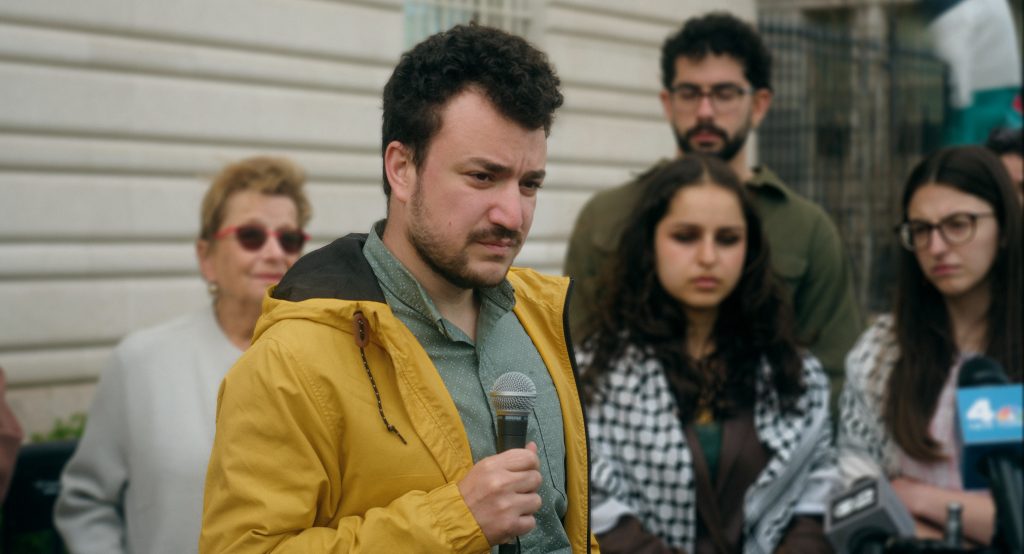
Mahmoud Khalil addresses a group on campus during the protests
Danielle Maisano: Did anything about the reaction to the film surprise you?
Michael Workman: The biggest surprise was the overwhelming support for the film. We were expecting more hostility than we received. We were really preparing for the worst, but it was surprising that even in the U.S., most of our press was pretty positive. Our press in the UK was a little more hostile, which is interesting. There are definitely some ideological differences between the press in the U.S. and the UK.
It’s been really moving to hear students reflect on their experience after watching the film, and feeling moved and re-energised. That was one of our primary goals, and for the most part, that’s been the students’ experience of the film. I think it shows that we need stories told by people in the movement who deeply understand it and can communicate the experience of being a part of these movements in a way that people outside of the movement can understand, while also reinvigorating the people who are in the movement and may be tired or feeling down because of how awful things feel or how insurmountable the odds seem.
When they see stories reflected in this way, they can see that they have power and that the repression they’re facing is actually a sign that they’re building power. If there weren’t this repression, it would mean they were irrelevant and not threatening to power. It’s really a sign to move forward and not retreat, and that’s been very inspiring to hear from students.
You cannot be neutral
You cannot be neutral to a voice.
You cannot turn it down to fit the limits of your hearing.
You cannot count us by bodies we are lives.
You cannot locate our cracks these make us legends.
We count our deaths as stories
that still breathe not numbers on a screen.
We count our resurrections.
We are here and everywhere
By Rana Abdulfattah
War
By Nasrin Parvaz
How Relevant is Socialism to Today’s Politics?
By Alain Alameddine
Capitalism won against the Soviet bloc and got to write the war’s history. Consequently, most of humankind’s view of Marxism or socialism is skewed. On the other hand, many socialists have adopted a doctrinal, quasi-religious viewpoint, which further taints society’s knowledge and appreciation of socialism, which limits a reality-based capacity for analytical political action (praxis). This poses at least three questions: What is socialism, and how is it relevant today? What about common objections that it is frivolous or outdated? Finally, since we aim to understand today’s politics, in order to change them, how are prevalent socialist views and arguments coming up short?
Bringing the lens of production and labour to the table
Many definitions of capitalism and socialism miss the point about what they are, oftentimes getting lost in descriptions that do not define the two systems. In a nutshell, the fundamental difference between the two revolves around what Marx called the “means of production”, which are everything workers use to produce goods and services, such as land, machines, tools or resources, the key question being: Should these means of production belong to private individuals or corporations, or must they be the property of society as a whole?
Capitalism states that the means of production can be the property of private individuals or corporations. Consequently, it states that the price paid for a good or service goes to the owners of the company that produced them, meaning they receive benefits, not from their work in producing the goods or services, but for the money they used to buy the means of production (this is the definition of “capital”). Workers who produce the goods or services then receive their wages as part of an agreement between them and the capital owners. Socialism states that the means of production should be the property of society as a whole, and that the value of the goods or services produced belongs fully to the workers who produced them.
The above question might seem like a theoretical one, best left to economic “experts”. But by focusing on the question of means of production and the value of labour, Marx and others both before and after him brought the lens on a key area, one that deeply —even tragically— affects society and human life. He showed that because capitalism allows some to make money without producing anything (what is today often called “passive income”), it effectively creates a parasitic class.
Capitalism is fundamentally anti-democratic, even criminal
This theft of workers’ labour is not just morally unjust, it is actually tragic for humankind: Capitalism allows for the accumulation of extreme wealth in the hands of a few individuals and corporations, and so ends up giving these few people unparalleled control of society by at least three means: First, clientelist control. For example, Amazon employs around 1.5 million individuals, which limits their freedom to take stances against Amazon’s policies. We have recently seen cases where those taking public stances against the genocide in Palestine lose their jobs in academic institutions or IT megacorporations.
Second, media monopoly. For example, 90% of French media is controlled by a few billionaires. A similar situation exists in the UK and even worldwide. This monopoly enabled tolerance of the genocide in Palestine and has hidden countless other genocides from European and North American populations.
Third, organisational capacity, including by means of lobbying. Capitalist industries support virtually all major political parties, which is a key reason why the US and the UK have only had two main political parties over hundreds of years. This allows these capitalists to enact policies that benefit them, such as the 1% lowering taxes on their businesses, the food and pharma industry legalising harmful foods and drugs, the armament industry making sure war candidates attain power or AIPAC making sure all key US presidential candidates are zionists.
For all these reasons, a system that allows the accumulation of capital is fundamentally antidemocratic. The genocide in Palestine has shown capital’s capacity to override popular will: While most Republican and Democratic party members were against the flow of US weaponry to the colony in 2024, both Republican and Democratic party candidates sided with it.
Theft of workers’ labour and capital’s undemocratic control are not the only problems with capitalism. Marx also analysed its effect on human happiness—a word scarcely used in capitalist slogans, although it is arguably a key human endeavour. For example, by separating workers from owning the means of production and from business decision-making, capitalism alienates workers from their work. The result is that instead of our work being something we enjoy, something we derive pleasure, satisfaction and meaning from, it is more often than not something we do because we must. Interestingly, this in turn leads to flawed conclusions, such as that humans are naturally lazy and would not work without financial incentive—a view that fails to explain hobbies (where we produce happily, on our “leisure” time after work), not to mention millennia of human history, production and creativity.
But, isn’t socialism unrealistic?
All life, human or otherwise, is tainted with suffering—at best, we grow sick, grow old and die. So there is no perfect economic or political model, and we must be able to critique socialism (more on that below). However, a number of objections to socialism are the product of capitalist hegemony over the discourse. Here are answers to four common objections.
“How can we live without private property? I want to own a house and a laptop!” — Socialism criticizes private property of means of production, not personal property. In a socialist country or world, we can own houses, laptops and as much as society is able to produce. Actually, the non-accumulation of wealth in the hands of a capitalist class means there is more to redistribute among the population.
“But competition is good and monopoly is bad” — There definitely is value to competition, and a number of socialist models allow for it. What it doesn’t allow for is the control of means of production that inevitably ends in precisely what capitalism claims to abhor: Monopoly. Just think of the very limited number of brands in fields such as electronics, automobile or distribution (such as Amazon). Even the thousands of brands we see in key sectors such as the food industry actually belong to just a handful of companies. Add that to the above-mentioned monopoly of political parties and media. And as mentioned, the accumulation of wealth allows these multibillion-dollar corporations to evade anti-monopoly laws.
“Isn’t socialism authoritarian?” — Almost all aspects of human rule have been authoritarian, and this includes the Stalinist version of “socialism” which dominated the socialist bloc during the 20th century. However, authoritarianism is not inherent to socialism as it is to capitalism, as it does not allow a capitalist class to exist and use its wealth to influence and/or reach power. The struggle to establish a polity where humans are equal and exercise democratic control of their affairs is ongoing and has yet to succeed.
“Sure, but socialism has failed” — Indeed, the socialist bloc lost the war to the capitalist bloc. This shows the socialist bloc was weaker, but it doesn’t show that socialism was wrong, i.e. that a capitalist class should own the means of production. By means of comparison, European settlers have succeeded at genociding entire populations and have largely been succeeding at it in Palestine since 1948. Does this mean settler colonialism is a good idea?
A critique of socialism
As mentioned, there is no perfect economic or political model. Many socialists today, however, still present themselves as Marxists or, in practice, tend to copy/paste ready-made classical socialist doctrines as quasi-religious truths. Critiquing socialist tools of analysis and political work is therefore key to remaining in touch with reality and presenting effective alternatives to capitalism.
This critique should include obvious mistakes, such as failed Marxist predictions. For example, Marx predicted that due to rising inequalities under capitalism, the working class would inevitably revolt. He further predicted this would start in countries where capitalism was most advanced, such as Germany or the UK, and that it would spread, override national identities and eventually become a global movement. Today’s socialists need not only to recognise these doctrinal flaws, but to understand what caused them and avoid repeating the same mistakes.
Among the mistakes are aspects of human society that fall outside the frame of Marxism. This includes Gramsci’s concept of cultural hegemony, which is a set of convictions and thinking patterns that society views as natural or normal and therefore does not attempt to challenge. This can include normalising private ownership of means of production or thinking that elections are the primary way of change. Classical socialism also takes little note of the effect of weaponising religious, ethnonational, sexual, gender or other identities. Identity can easily appeal to primal instincts and trigger emotions that eclipse even direct material interests, particularly true in group settings such as collective identities. Other political projects, such as settler colonialism, can also include aspects that fall outside the lens of production and labour. For example, in Palestine, working-class settlers occupy the lands of an ethnically razed Palestinian bourgeoisie.
Finally, some aspects of classical socialism are no longer as relevant as they used to be. The industrialisation of agriculture means that most of what Marx taught regarding farmers is now irrelevant. The prevalence of self-employed freelancers, particularly those who work online, means that traditional analyses focused on ownership of means of production are no longer valid, as the means of production (often just a laptop and an Internet connection) can cost as low as a week’s wage. A copy/pasted Marxism would consider billionaires like Lionel Messi to be working class, since he only sells the value of his labour. Classical tools of analysis are also inadequate for a proper understanding of technofeudalism, an economic system where tech companies function like modern feudal lords: Not owning means of production but making businesses pay for the right to use the electronic spaces they control and that are necessary for these businesses to thrive. The growth and prevalence of artificial intelligence, which threatens to render much of human labour itself irrelevant, is further likely to exacerbate the irrelevance of a number of classical socialist tools.
All of the above can be summed up in two key concepts: First, capitalism cannot be reformed. As long as capital is allowed to be privately accumulated, capitalists will control society. True democracy is contingent on the defeat of capitalism. Second, classical —and particularly doctrinal— socialism cannot bring about radical change. This means that revolutionary individuals and organisations must build the capacity to analyse the dynamics sustaining existing political systems, prepare relevant and adapted revolutionary roadmaps and engage in such work. This capacity can be built when revolutionaries grasp analytical tools, but also develop the critical capacity required to keep in touch with reality instead of doctrinalising tools as ready-made solutions.
Although the capitalist system is heavily entrenched and has so far managed to survive all of its contradictions, many crises await it in the near future. These might include AI replacing human labour, the possibility of AI going rogue, a confrontation between the US and China, the environmental crisis, new and possibly harsher Covid-like plagues, or other human-made or natural disasters. At that point, revolutionary organisations that are capable of grasping what is happening and that have built the capacity to act decisively toward revolutionary changes might be able to turn such crises into opportunities. Now is the time to build such organisations. This is a call to action.