Kill It Before It Dies
By Jacob Smith
In late May of 2024, Scottish producer and artist KAVARI went to the hospital. She required invasive surgery and a night’s stay on the ward. She had been listening to I want you to breathe – Asphyxiation Mix with her headphones at full volume. Repeated exposure to the track’s strange alchemy of night-black bass, fleshy breakbeats and swelling vocal samples had proved too much. Severe auditory damage. Her body had started to fail. Like the smothering effect the track’s title describes, the music had overwhelmed her organic functions to the point of breakdown.
Asphyxiation Mix frontloads the bodily experience of too much. The pop of the eardrums, the bleaching of the synapses. Hers is an extreme sound, both musically and experientially, in her live shows. Speakers rattle and shake, walls of sound undulate through the dance floor in a way that tightens your throat. But unlike the sounds of other noise extremists like Merzbow, KAVARI pulls back from what would be the sound of oblivion. Something inhibits the noise; something like melody emerges from the dark. The extremity of her soundscapes, self-reflexively depicted in her explicit play of the human sensorium, marks KAVARI’s sound. It’s what Aphex Twin declared as ‘some of the most brilliant, most interesting kicking electronic music’ to come out of the underground in the past few years.
The primary thing to note is that her integration of bodily destruction stands out against the majoritarian synthetic beauty of British dance music. Instead of a sharpened breakbeat in Asphyxiation Mix, we get a black inky morass of bass, only just distinguishable as a percussive element through its contrast with the snare, which itself sounds like wood hitting flesh. KAVARI’S voices invert rave music’s typical treatment of vocal samples. They become unchained from their rhythmic percussive impetus. But still KAVARI maintains those core dance tenets: 4×4 breakbeats, large bassy rumbles, heavy sampling. Far from an anomalous entity in British dance music, KAVARI’s is a sound embedded within the creative logic of rave as a techno-musical enterprise. Hers is a direct extension of rave culture.
However, her centring of the body is crucial. It is the mark of her difference. KAVARI’s multimedia project plays with different configurations of ameliorated bodily experience—from the muffled screams of sexual assault simulated in 2023’s Against the Wood, Opposed to Flesh, to her blood paintings created by slicing herself open and bleeding onto the canvas. In her use of death and bodily reconfiguration, KAVARI demarcates an original space against the contemporary crisis of newness that afflicts a majority of both dance and mainstream music culture. But, in doing so, in frontloading destruction and death as a creative core in her work, she also reveals the central problem inhibiting the contemporary emergence of the new. Her newness is linked inherently to the very critical failure that afflicts originality in the contemporary music landscape. KAVARI’s use of death as the creative impetus in her work reveals something structurally integral to creativity in general and the musical culture of digitality specifically.
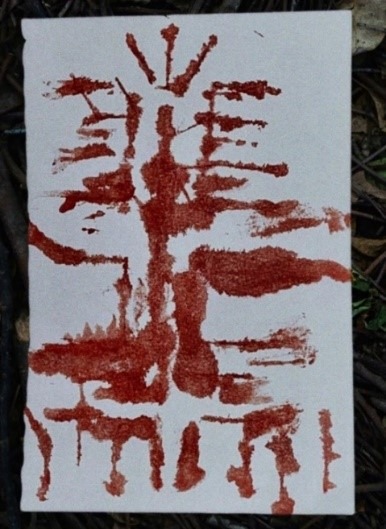
Today’s crisis of the new is that there exists too much death. Death not as a site of annihilation or nothingness, but instead as a generative well from which creativity springs. What is at play is not necessarily a capitalist crisis of imagination, but of that which generates imagination: a crisis occurring at the interaction between newness, death and technology.
What do I mean by the crisis of the ‘new’?
In a talk entitled Death of Rave in 2013, the theorist Alex Williams remarked that where once ‘dance music was able to conjure entire new genres, as well as generating entirely unheard sonic effects’ the milieu has since ‘become markedly sclerotic.’ Something in the culture had slowed down. Those large musical generic leaps of the 20th century had become inhibited: ‘imagine playing a piece of mid-nineties jungle to someone from the 1970s, and they would be absolutely astounded. But play a piece of current bass music to someone from the early 1990s… and there would be no such reaction.’ 12 years after this talk was given, it is clear that this cultural malfeasance was overstated. Playing Death Grips’ Hot Head to someone from 1996 would hardly conjure feelings of familiarity. But what Williams does successfully identify is that those mainstream generic bursts that cause music culture to significantly shift in the 20th century—from Elvis to the Beatles, punk onto jungle—have slowed significantly.
What has occurred instead is a generalised dissolving of genre as traditionally conceived. In the age of the internet, music’s generic configurations are defined by the absence of generic boundaries. Genre is liquid, a smorgasbord of various influences, memetic resonances and ironic attachments. In mainstream pop, an artist like Charli XCX creates bombastic 2000s-era club music, and experimentalist music like the hip-hop-glitch-punk of JPEGMAFIA or the dubstep-pleasure-doom of 100 gecs gets tens of millions of streams. While this situation provides fertile ground for interesting experimentation, the dissolving of genre also afflicts the concept of the ‘new.’ Those kinds of generic shifts in the 20th century become difficult to conceptualise when the bedrock of those shifts is removed.
This generic dissolution has its roots in the political and economic consequences of the digital turn. Digital production techniques increase the speed and efficiency of music-making. No longer does the artist need a studio. Hits can be made in the bedroom. It has also never been easier to consume music, which provides a telling problem for those labouring in the contemporary industry. The compensatory mechanisms of a ubiquitous streaming culture mean that artists often don’t see adequate pay for their output, and are often prohibited from the kind of large-scale touring and distributive traditions that once allowed the cross-pollination of subcultural sounds into the mainstream. Cultures like punk and hip-hop in the 1970s and ‘90s burgeoned, in part, because artists were not automatically thousands of pounds in the hole just for carrying out a small tour. In this way, digital mechanisms favour the consumption side of musical creation as opposed to production. As Timothy D. Taylor writes in Music and Capitalism: A History of the Present, the ‘rise of digital technologies has created certain efficiencies, which are exploited by… music production companies.’ Touring, independent distribution, and the maintenance of small venues—all of these crucial elements in musical emergence become prohibitively expensive when adequate compensation is not provided. The effect of this unbalanced distribution of efficiency is that while digitality produces ‘new’ music with its ease of experimentation, this music falls into a cultural stratum whereby the new is cordoned off in specific digital and offline spaces. The mutative core of culture—its twists, turns, and breakthroughs—rests upon economic and material structures that, if changed, profoundly influence where new music comes from and how it intervenes in broader cultural formations.
Is it simply that there are loads of geniuses out there, creating immensely consequential and incredible music, only for their art to be lost in an industry that refuses to support them? Here we come to the affective dimension of the contemporary situation: how it interacts with the complicated internal lives of those who live under it. Theorists on the left bemoan a contemporary conjuncture that inhibits collective cultural imagination. These theories have dramatic names—from the cultural logic of late capitalism, to the slow cancellation of the future, to the condition of digitality. They are best summed up in Fredric Jameson’s statement that ‘it is easier to imagine the end of the world than the end of capitalism.’ For these theorists, the crisis of imagination reaches its apex in our post-Cold War era, where the only viable system presented by the political class, trickling into cultural artefacts, is neoliberal capitalism. Within this stultified political and economic situation emerges a culture that is inherently nostalgic, a retrograde contemporaneity. Political commentary sees Trump 2.0 as a return to the Gilded Age or a redo of fascism. Bands like Fontaines D.C., Black Country, New Road and black midi—hailed as emergent originals by the musical commentariat—produce guitar music akin to a large amount of ‘80s and ‘90s post-punk. And in the mainstream, an artist like Dua Lipa has found her most successful record to date to be a disco throwback LP. These theorists argue that the new is afflicted by an all-pervasive closure of the imagination that affects every subject under capitalism. The pessimistic implication is that there cannot be new cultural forms in a socio-economic system obsessed with narcissistic replication. The new, therefore, has died.
In music circles, ‘90s-era rave has been canonised as the last gasp of the new in British music culture. Against the deliberate ‘60s cosplay of Britpop, rave provided a strange and sweaty alternative. There is a logic in rave music—and in KAVARI’s extensions of it—that reveals how digital technology intervenes in creative production. Digitality affects musical production on the level of ontological structure. We can locate the crisis of the new not just within the artist-scalping tendencies of greedy capitalists, or the affective tendency of an all-pervasive late capitalist realism, but within the way that digital techniques alter creativity. This has to do with the use of death. Death as a function. It is a technique that KAVARI utilises expertly.
In religion, death is the passage between one reality and another plane existing outside of the limits of the body. In biology, it is often the transference of life-giving energy from one organism to another through complex scientific processes. It is important in this case, then, to view death not as the absence of vitality, movement, or action, but instead as a place where the new begins. Death is not the endpoint; it is an end. It is the end of a certain organisation—of an organism, of a structure, of a genre. An end to continuity, a failure of adequate repetition. As Deleuze and Guattari remind us, ‘Dismantling the organism has never meant killing oneself, but rather opening the body to connections.’ Death is the moment where a stratified reality breaks down, opening itself up to something not yet conceptualised. Death is an endpoint and a beginning; it is the passage to a necessary reformation.
What made rave culture new on a technical level was its emphasis on digital sampling, and this emphasis hyper-charged the creative relationship with death. A genre like jungle’s amalgam of reggae, hip-hop, jazz and whatever else could not have occurred without both the shifting demographic makeup of post-war Britain and the ease of chopping and changing allowed by digital technology. As Taylor makes clear, jungle is ‘an early example of how processes of composition or songwriting . . . could begin to be available to everyone with access to digital technologies.’ Jungle—and rave more generally—implemented a form of sampling much more extreme than that of hip-hop. Where hip-hop’s use of sampling developed beats out of previously released music, rave’s sampling distorted these original sounds beyond recognition. In Tribe’s Can I Kick it? the sound of Lou Reed’s Walk on the Wild Side is immediate. Joe Chambers’ piano line in Mind Rain was left virtually untouched when sampled by DJ Premier for Nas’ NY State of Mind. In contrast, an album like Photek’s Modus Operandi, which samples Stomu Yamash’ta’s 33 1/3 across several tracks, stretches the original to the point of complete disjunction. The samples become amputated from their source material such that, in the sonic palette of rave, the original withers and dies. In this way, rave strips its influences to the point of killing them. The newness of rave was down to its novel relationship with the originals from which it sampled. It was a relationship that privileged removal and death over the reworkings of the hip-hop tradition. Rave coincides with the destruction of generic distinction in earnest, both aesthetically in its sound and technically in its production.
Rave privileges the unalive nature of the sounds it produces. You do not hear drums in rave, but a murdered breakbeat from the mid-20th century. Even the organic becomes instrumentalised such that it exceeds its limits. Vocal samples have nothing to do with the mouth or the lungs, but the percussive potential of their reintegration. ‘Voices are molecularized into chattering, gibbering textures,’ wrote Kodwo Eshun in 1998, ‘new textures standing on the borders between solid and liquid.’ Goldie’s Timeless is a great example of this. As Simon Reynolds wrote in 1994, Goldie’s technique of timestretching ‘made it possible to stretch a sample (vocal, whatever) so that it fits any beats per minute ratio, without changing its pitch.’ The voice is subordinated to the machinic ensemble within which it sits. Far from being the front and centre of the junglist musical enterprise, the voice becomes another feature within its rhythmic assemblage.
The central generative feature of rave as a new form was the supercharging of death. Here lies the awkwardness in the melancholic worship of ‘90s-era rave as somehow anathema to capitalist culture. Capitalism dismantles stratified realities incredibly well. It is very good at decoding and reforming, at sampling and reproducing, at entering new territories and colonising them. Deleuze and Guattari once more in Anti-Oedipus: ‘the more it breaks down, the more it schizo-phrenizes, the better it works, the American way.’ Capitalism instrumentalises death so it can develop new spaces and structures to plunder and exploit. Far from being an antithetical product in the capitalist cultural market, rave is the maturation of a cultural tendency within capitalism towards reconstitution, remixing and change—towards death. However, there has to be a limit. ‘Does capital exploit the workers to death?’ asks the Baudrillard of Symbolic Exchange and Death. ‘Paradoxically, the worst it inflicts on them is refusing them death. It is by refusing their death that they are made into slaves.’ Death can never allow itself to be fully realised in a system of exploitation, because it would turn upon itself. The line between the rave moment in the ‘90s and the situation now, where experimentation is encouraged technically (by digital technology) but inhibited materially (by the industrial location of that technology) is not the co-option of that technology’s potential by greedy capitalists. Instead, it is simply a development in capitalism’s generative relationship with death and becoming.
This is not to say that death is the ultimate core of creative work and imagination. But it is to say that this generative creative element is one that is readily instrumentalised. The structure of creativity, and its relationship to death, has been injected with the steroid of digital production and sampling. The tendency within these techniques towards reorganization and dissolution affects both broad generic configurations and individual artistic enterprise.
Listen again to KAVARI’s Asphyxiation Mix. What emerges from the black ink of KAVARI’s bassline? A broken and filtered voice whispering, ‘It makes it so much easier, I want you to breathe,’ alongside light breathing. Initially, the vocals cut off at vital points so they sit as a rhythmic element within the track. But as the track goes on, the voice begins to writhe free. A turning point occurs just after the minute mark, where percussion falls away, and the vocals move to the centre. KAVARI places the sample above the wall of bass that follows, leaving it relatively untouched except for the end where ‘breathe’ is repeated. Then the vocal samples come to dominate the track. They swell and twirl and attack from all sides. And while these voices may overshadow the track, what takes real primacy is the sound of breathing. Against that inhuman digitised soundscape emerges a human body gasping for air.
With this track, KAVARI establishes a throughline of bodily function that sits beside instead of in the track’s rhythmic assemblage. Unlike the tradition of vocal samples in rave, typically sutured to the rhythm of the piece as a whole, the human voice does not try and integrate itself back into the track’s percussion. As the track continues, the breath becomes more ragged and pained, ending with the implication of death: ‘you might go lightheaded but it’s all part of the game.’ This deliberate contrast of soft breath and digitised vocal manipulation front-loads death in two senses. The first is the digital manipulation itself, the ripping of vocal sounds away from the vocal cords. The second is the airy fragility of the breath itself, the figuration of slowing lungs, the implication of demise. The track may sound like you’re being smothered, but it is not the sound of something dying. It is instead the integration of death as a function of musical creation.
KAVARI’s fleshy, pummelled soundscapes and elevation of human sounds paradoxically reveal this function by inverting rave as a death-form. KAVARI rescues human sounds and elevates them above the rhythmic engine of rave, in doing so exposing the relationship that lies at the heart of rave as a productive technique. The human is not dissolved into the machine, but it is the machine that is made human, subordinating both to a process of death and destruction. Today’s crisis of the new is not down to a generalised lack of imagination. It is instead down to a limiting inhibition underneath the supercharged experimental creativity induced by digital technology—the fact that death cannot be absolute. Could KAVARI’s be a music of post-capitalism where her elevation of the death-function is a symptom of a fundamental reworking of cultural and political economy? Maybe there is something telling in the nakedness of her creative relationship with a digitally mediated death: a kind of break with the melancholia of past newness into the annihilation of pure black sounds. In the words of one of KAVARI’s many voices: the more you scream, the more he likes it.


