The Last Cigarette
Art and Political Prefiguration
By Elettra Stamboulis
I ceased smoking in May 2023. It was not a simple matter. No, I did not intend to quit smoking, but to detach myself from him, from my grandfather.
He would awaken at five in the morning, a habit acquired during his confinement and imprisonment. He would perform a series of push-ups each morning— another custom borne of prison, a means of survival in enclosed and cramped spaces. Then, he would light a cigarette. When I was in Athens, I slept in their room. The smoke never bothered me. My grandmother recounted that when he was on Makronisos, I believe during the Civil War, he would refuse the food parcel. He wanted only cigarettes. When I asked him, shortly before his death, why he preferred cigarettes to feta, he told me, “You see, when you find yourself in a state of humiliation, deprivation, when they seek to strip you of everything, most of all your dignity, you must perform a gesture that restores you to the freedom of your human being. The cigarette is useless, precisely for this reason, it is essential in such moments.” I believe art is like those cigarettes, perhaps useless, yet essential.
In the new century, we have witnessed an explosion of the most insidious and ambiguous aspects of financial capitalism, of post-capitalism, and within this explosion, art too has undergone a detonation. The artist, who had become emancipated from the role of courtier in the 19th century, the artist who had seen their role transform, no longer an instrument of power but an interpreter of conflicts and wounds— behold, that artist has now been silenced by the art market, by its voracious appetite for digital images, and is easily blackmailed, precisely from a financial standpoint and beyond.
From 1999 to 2019, for twenty years, I worked with many artists, primarily from the international underground. I speak of the generation born between the late 1960s and the 1970s, in particular those from North Africa, Turkey, Lebanon, in addition, of course, to Italians and Europeans in general. Over the years, I became an expert in visas, one of the most complex and delicate matters for the very possibility of an artist’s growth and dialogue with other places.
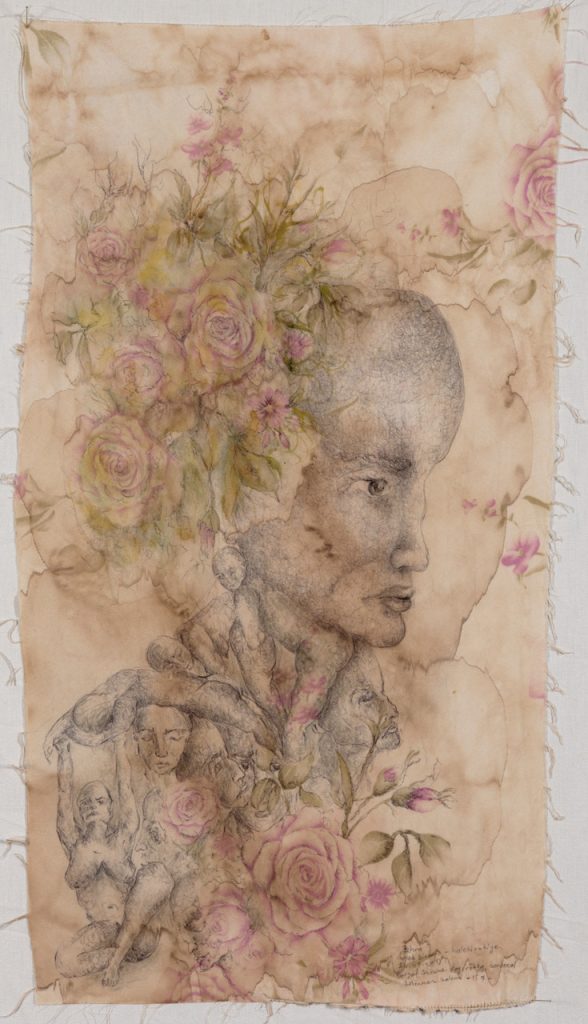
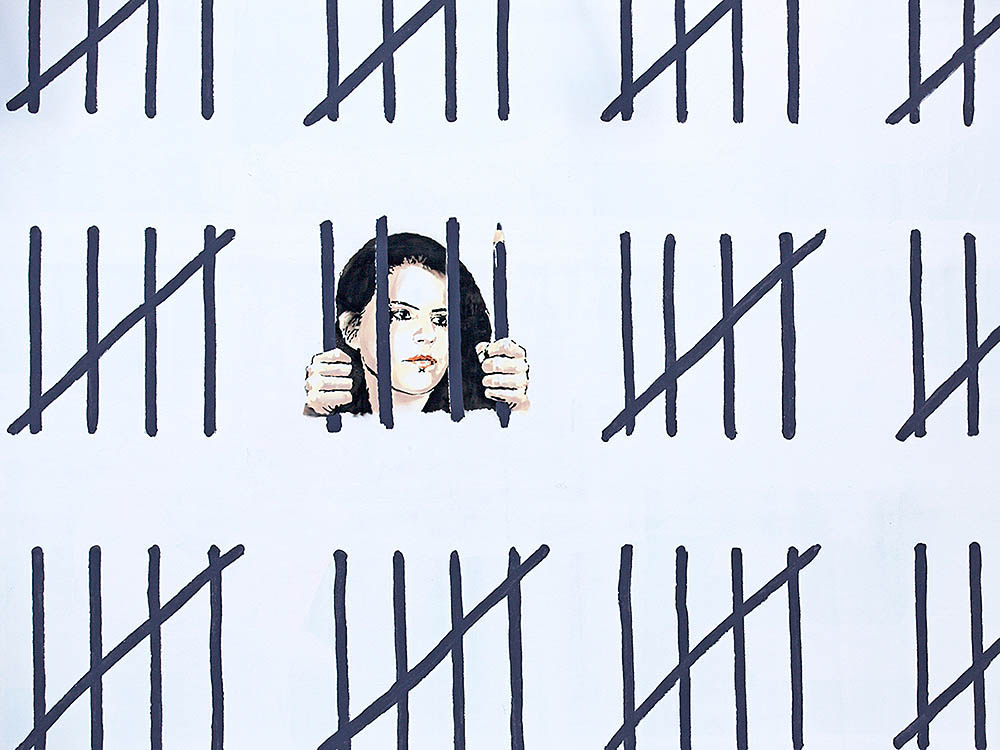
In 2019, I encountered an artist who had been in Turkish prisons for creating a drawing on a photograph of soldiers celebrating after the destruction of Nusaybin, in Turkish Kurdistan in 2016— an event that caused the displacement of more than 300,000 Kurds from the area and the destruction of 70% of the city. Zehra Doğan, not yet thirty years old, had been incarcerated for 2 years and 9 months for that drawing. I became acquainted with her work in a small town in Normandy, Morlaix, where some French activists had exhibited works she had smuggled out of prison through a discreet channel between Turkey and France. Above all, I met Naz Oke, a Turkish human rights activist naturalised as a French citizen, who saved Zehra’s works, archived them in her home, and, together with me and a few others, took care of her upon her release from prison. Her exhibition, “We Will Also Have Better Days,” was the first in a series I organised in Brescia, featuring artists who, due to their ideas and their work, had been forced to leave their countries. Art’s refugees, in short. Some believe these artists receive attention for what they say, for what they represent, and not for what they create. As if a viable schism could exist between art and life, between thought and action.
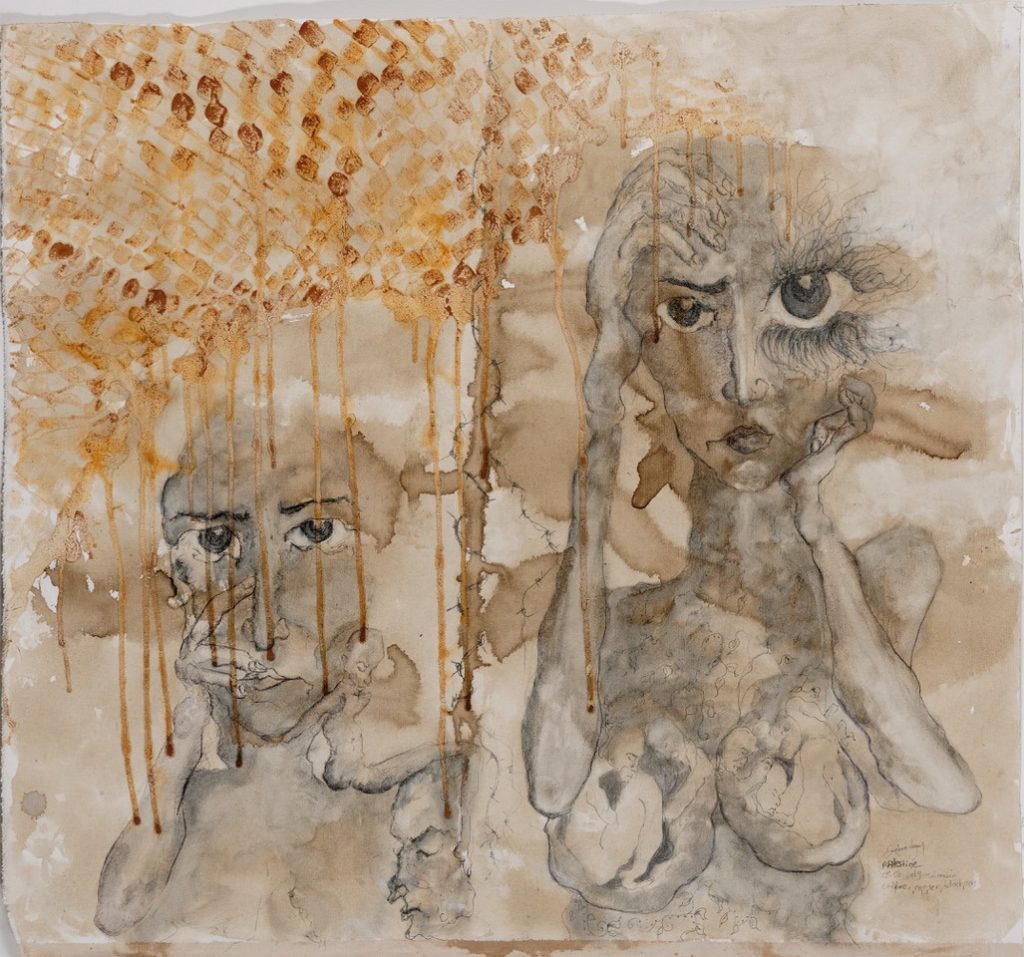
Nevertheless, it is true that it is highly risky for an artist to be confined within a cage of meaning reduced solely to their personal history and the history of their country or people. The propensity to label an artist as ‘political,’ only to discard them the moment they or their cause are no longer ‘in vogue,’ or no longer marketable in terms of media attention, is a central theme of their potential for blackmail.
Zehra now resides in Berlin, unable to return to Turkey. She collaborates with an Italian gallery that provides her with financial support, enabling her to sustain her family who remain in Turkey. Yet, her visa stands as her most crucial work, the one she preserves and worries over daily. Her artistic and political credibility perpetually hangs on the facile categorisation of “the prison artist.” Is it possible, she wonders, to be recognised as an artist, a feminist, a Kurd, an activist, without succumbing to the supermarket-style classifications of the art fairs? A difficult, if not impossible, endeavour.
Navigating any of the significant art fairs, those that constitute the lifeblood of the art market index, reveals that these artists are, in essence, substantially excluded. They can exist only when bolstered by public and private foundations concerned with the post-colonial repositioning of the artistic gaze. These entities impose display rules, sometimes dismissed as excessive or moralistic, yet they represent the only possible leverage to ensure that African American artists find a market, that artists from the global peripheries are recognised and promoted, and that our perspective decentralises itself, becoming curious about the perspectives of others. The sovereigntist, authoritarian, and post-fascist movement— which views Trump as its most influential politician but boasts significant exponents across Europe, Latin America, and Asia— is not disinterested in this curatorial debate. The events of May 2025 at the Whitney, with the cancellation of the performance No Aesthetics Outside my Freedom: Mourning, Militancy and Performance, are emblematic: self-censorship is undoubtedly one of the most widely practised forms of compliance by cultural institutions. When it comes to Gaza or the Palestinian question, this instrument continues to inflict damage, primarily upon our capacity to comprehend Palestinian artistic culture.
If you are not acquainted with the artists of a country, your potential for empathy towards its inhabitants diminishes considerably. This holds true for all arts and all cultural forms. Furthermore, cultural geography today plays an outsized role, amplified by the weakness of its cartographic counterpart in the age of Google Maps. We can, indeed, identify a locale’s restaurants from afar, but we cannot discern its culture. A form of colonialism proliferates in the wake of the globe’s digitalisation.
The insistence with which right-wing factions of all intensities— there being no distinction in this between conservatives and neo-fascists— defend a unique cultural identity, primarily the so-called Western one, but also neo-colonial narratives like those in Putin’s Russia or neo-Ottoman ones in Erdoğan’s Turkey, is precisely aimed at creating a uniform, normalising discourse. It promotes an artistic vision that questions none of the contradictions of the contemporary. Normalising perspectives is part of the autocratic discourse, and it works.
The violence of the system is not only the spectacular, precise violence of bloodshed: there is a violence of tedious and insubstantial forms designed to render us all subjects, such as the practices of visas and residence permits, which are widely used to silence and exclude artists and intellectuals. These bureaucratic forms of control, employed as structural violence, do not target everyone: merely complaining about “bureaucracy” in our lives does not automatically render it an element of violence, though it is certainly a nuisance. It is the implicit and explicit forms of blackmail underlying the issuance of residence visas, impacting primary rights like freedom of expression and movement, that constitute structural violence, to use David Graeber’s term. This same Graeber, when analysing the processes by which irreverent artistic forms were used during the alter-globalisation protests of the late 1990s, and the police reactions to them—particularly the giant puppet— he speaks, in his analysis, of prefigurative politics. That is, groups deciding to act as if they were already free, without waiting for a liberated future. In a certain sense, the artistic practices of dissident artists possess precisely these characteristics. They act as if they were already free to express themselves without censorship, without propaganda, with their gaze liberated. Zehra Doğan not only took the liberty of transforming a photo of Turkish military armoured vehicles into scorpions, but she continued to paint in prison using coffee, food residues, menstrual blood, and, obviously, cigarettes, thereby checkmating the system of liberty deprivation perpetrated by the prison regime.
The art market imposes other constraints, often bureaucratic, typically exclusions stemming from a censorship that limits our capacity for a full gaze. This is a censorship born more from forms of cultural conformism than from conscious exclusion. Any exhibition that revisits a period of genuine liberation exposes this aspect: many of the artists who played a relevant and crucial role in that period are simply absent from subsequent phases of normalisation.
True art is prefigurative politics; that is, it allows us to imagine ourselves free even when we are not. It is within that empty space that we must look, avoiding wasting time on the shelves of mouldy and conformist products in official art fairs. It is, precisely, our last cigarette.


